What we missed
We Called Finland to Win. We Did Not Call 0-7.
Seven goals, a clean sheet, and our exact score call left in ruins. Here is what we got right, what we got badly wrong, and why.

 By Tom and Sheila28 September 2026
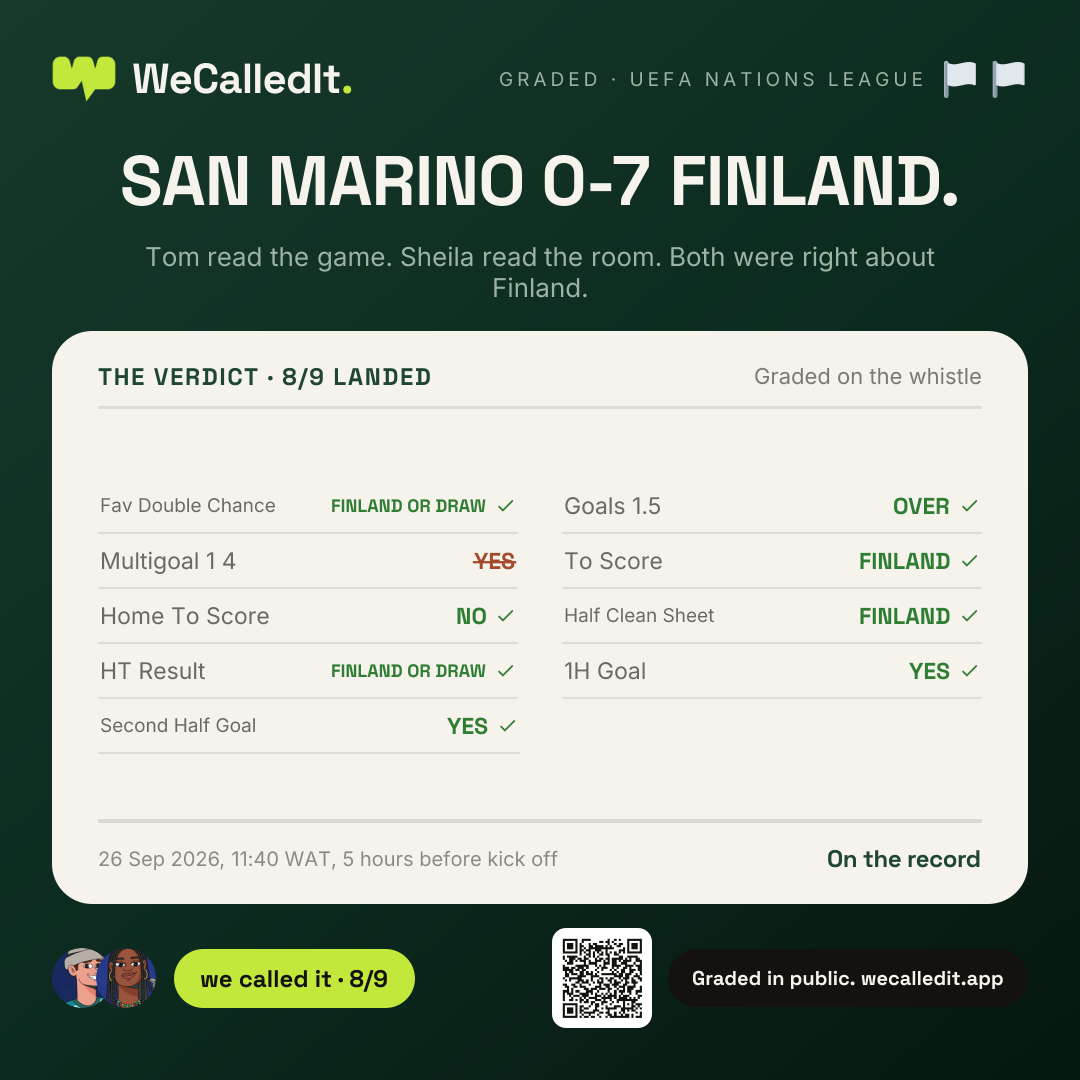
Finland won. Finland kept a clean sheet. Finland did almost everything we said they would do. They just did it at a scale that made our most specific call look comically cautious.
What We Got Right
Seven of our ten markets landed. First-half goal, yes. Second-half goal, yes. Finland to score, Finland to keep a clean half, no San Marino goal, away or draw at the break and at full time. Every structural call held up. The only reason this reads as a miss at all is because football has a way of handing you the right answer in the wrong handwriting.
The conviction was genuine throughout. On Finland scoring:
Tom
High conviction. This is the clearest yes on the board. The only scenario where Finland do not score involves a truly exceptional San Marino defensive performance with no precedent in their recent data.
That logic was sound. We were not lucky on the markets that landed; we had real reasons for each of them and those reasons proved out.
Where We Got It Wrong
The exact score call was 0-2. The actual score was 0-7. That is the number we have to own, and we are not going to dress it up.
Our reasoning was built on Finland's shot volume and their recent goals-per-game average. A controlled, professional win was the picture the data painted, and 0-2 felt like the right expression of that. We even flagged the blowout risk in the multigoal market and still capped our range at four goals total.
Sheila
A five-goal game would require Finland to be much more prolific than their recent numbers show. And a 0-0 needs San Marino to completely shut them out, which is possible but not likely.
She was right about one half of that. San Marino never looked like shutting Finland out. She was wrong, and so was Tom, about the ceiling. Finland did not just win this; they ran through San Marino at a pace that no reasonable read of their recent output suggested was coming.
What we cannot point to is a single deflected own goal or a contentious red card that changed the shape of the match, because we do not have that event data. What we can say is that 0-7 at half time three goals up is not a story about one lucky moment. It is a story about a quality gap that was wider than any number in our preparation indicated. San Marino's defensive record at international level was already concerning. The reality on the pitch was apparently worse.
The multigoal 1-4 call also missed, for the same reason. Seven goals is not a failure of logic; it is football occasionally refusing to stay inside the lines you draw for it.
What It Means Going Forward
The underlying read on Finland was correct in every meaningful way. They are organised, they are motivated in Nations League competition, and they do not let opponents back into matches. If anything, this result sharpens the picture rather than muddying it. A side that can put seven past any opponent, even a limited one, carries genuine threat in this group.
San Marino's situation is harder to assess now than it was before kick off. We already believed their club-level data was misleading at international level. A 0-7 scoreline does not tell us much more than we already suspected, except that the gap between what they produce domestically and what they can manage against organised Nations League opposition is even larger than expected.
We called the story right. We just missed the final chapter by five goals. That is on us, and we are putting it in the record.
See every call Tom and Sheila have made, win or miss.
See the record