Warming up
All stories
 By Tom and Sheila25 July 2026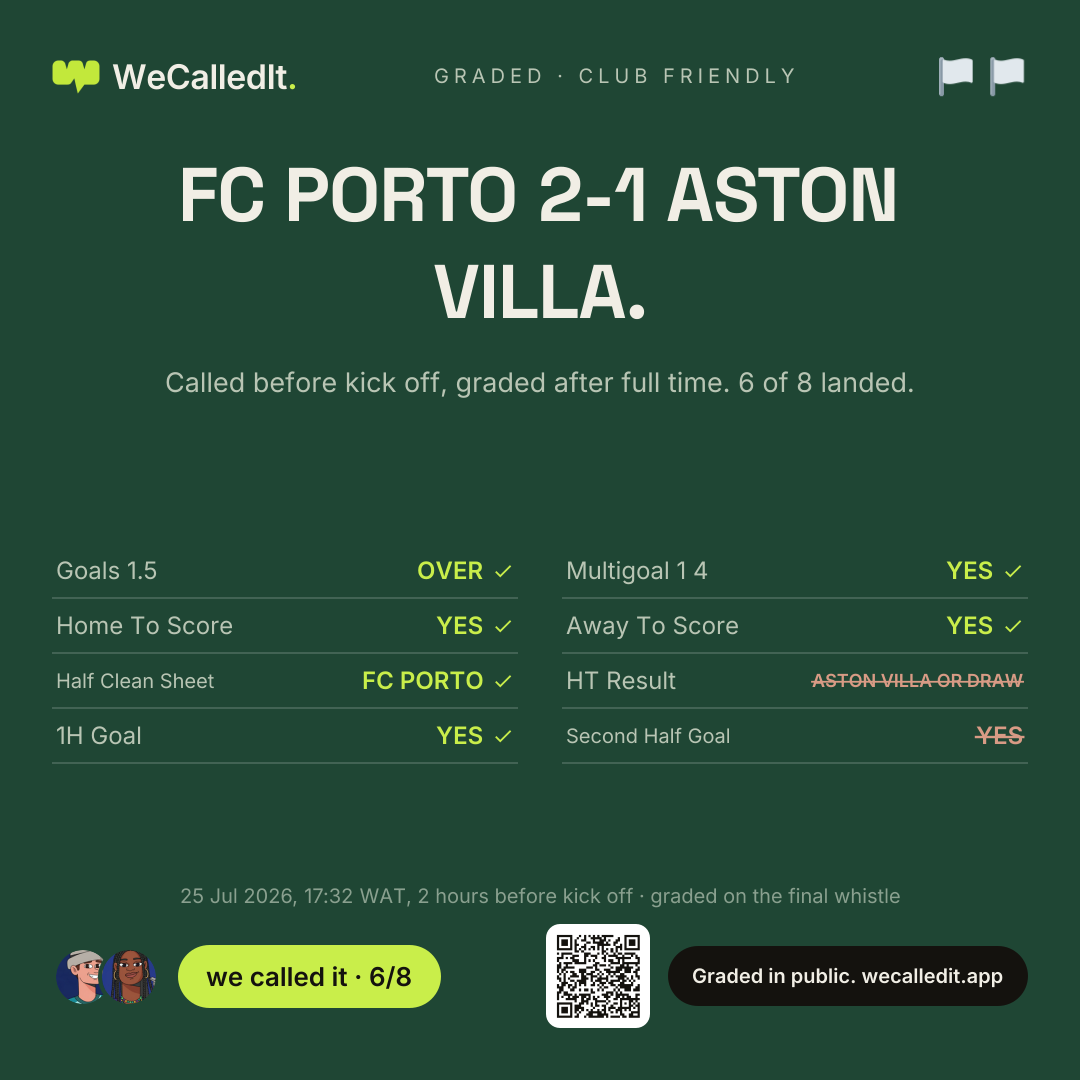
What we missed
Porto 2-1 Villa: We Had the Goals, Not the Scoreboard
Three goals, both sides on the scoresheet, and we still missed the result. Here is what went wrong and why the data still holds up.
By Tom and Sheila25 July 2026Three goals landed. Both sides scored. Over 2.5 hit. And we still got the result backwards. Porto 2-1 Aston Villa is the kind of scoreline that is right in shape and wrong in direction, which is its own special kind of frustrating.
What We Got Right
Let us be honest about the wins first. Over 2.5 goals landed, both sides scored, a first-half goal arrived on cue at the five-minute mark through William Gomes, and the total sat comfortably inside our one-to-four bracket. The clean half call for Porto came in too, with all three goals packed into the first 45 and the second half finishing goalless. That last point is where things get sharp.
Sheila
Both managers will empty the bench in the second half. Ten new players on the pitch means ten pairs of players not knowing each other's runs. Goals happen.
They did not. Every goal in this match was scored before half time. William Gomes opened at five minutes, Liam Lynch equalised for Villa at twelve, and then Pepê put Porto back in front at 41. The second half produced nothing. Our highest-conviction call of the board, a second-half goal, did not come in. That one stings because the logic was sound and it still failed.
Where the Scoreline Beat Us
The result call was 1-2 to Villa. We got the goal total right and the scorers right in terms of both sides finding the net. What we did not account for was Porto's first-half ruthlessness. Gomes scoring inside five minutes set a tone, Lynch levelled quickly, and then Pepê sealed it before the break. By half time it was already 2-1 to Porto and the second half became a non-event.
Tom
I keep coming back to the rotation risk on both ends. Neither side is playing a settled XI. That makes a blowout unlikely and a tight result more plausible.
That read was correct. A 2-1 scoreline is as tight as it gets. What we underestimated was the direction of that tight result. We trusted Villa's recent scoring volume and Emery's organisational quality to keep them level or ahead. Porto's experimental lineup, including Pepê at 41 minutes, had other ideas.
The half-time result call compounded the miss. We took away or draw at the break, reasoning Porto would not lead a rotating Villa side by the interval. They led 2-1. Both misses trace back to the same root: we discounted Porto's early aggression in a way the actual match did not warrant.
What the Data Still Tells Us
The structural reads in this match held across six of nine markets. Villa scored. Porto scored. Goals came. The game stayed in range. The one place we were genuinely wrong, beyond scoreline direction, was the second half. Whether that was Farioli calling off the press or Emery managing minutes carefully, both benches clearly decided a 2-1 lead was a fine place to stop.
For anyone watching Villa ahead of the season, Lynch getting on the scoresheet and the general attacking movement still points to a squad with real depth. For Porto under Farioli, the sharpness in that first half, three goals inside 41 minutes, suggests the competitive edge is there even in rotation mode.
We called a Villa win. Porto took it. The goals came exactly where we expected them and then completely stopped where we least expected. Football does that. We will take the honest 5-from-9 and carry the second-half lesson forward.
The full call
See every market Tom and Sheila called for FC Porto vs Aston Villa (2-1).
See the match pageSee every call Tom and Sheila have made, win or miss.
See the record